Yeah, the latter! We went down to the Chaudière-Appalaches region, an area just to the south and east of Quebec City to camp at a quiet spot on the Etchemin River. The days were warm and dry but not hot, something of a relief after a particularly stormy and humid spell.
Camp here? Ok!
The Etchemin is not a mighty river but it is mighty cool, both to sit alongside and to dip a foot or two into the water. Not so deep in dryish high summer, and navigable by canoe if you don’t mind a bump or two. We chatted to a family of four who successfully paddled stretches of the Etchemin without drama, and that was with two youngsters under ten and a dog. It’s got us thinking about giving it a paddle another time…
The Etchemin, man
We saw a couple head down to fish for an hour or two. I don’t know if they caught anything, but did they ever look happy just to be there! A sleepy river? No, not really, more of a tranquil space, one where plenty was happening.
I’m reading “A River Never Sleeps” by Roderick L. Haig-Brown, and thoroughly enjoying it. An account of his fishing life, I’ve only read the opening chapters so far, and what a dry wit he has. The section on mythic fish is tale telling at its best. I know almost nothing about fishing, having barely any experience, but Haig-Brown’s enthusiasm is catching. His descriptions of rivers he loved on Vancouver Island are wonderful. A new title to me, and highly recommended if it’s a new title to you!
Eagles soaring – but not in this photo
Each day we’d sit by the bubbling and chuckling river, the water sparkling in the bright sun. So much to see! We observed several large eagles climbing in circles, higher and higher to reach a certain height, then swoop down in long and graceful glides. Small birds chattered in the bushes and trees lining the river, with some seeming keen to make a start on the ripening berries. It was a delight to watch a heron across from us, moving with that slow and steady wing beat, an almost lazy, effortless flight upriver and away.
The wider region is a patchwork of wooded hills and pockets of cleared farmland, with many, many small streams and rivers. There’s the bustle and busyness of productive agriculture, and in such pretty surroundings the pace seems bearable. It’s easy to romanticize farming life on gentle summer afternoons if you’re not the one on the tractor or in barns and sheds, tending to crops and livestock…
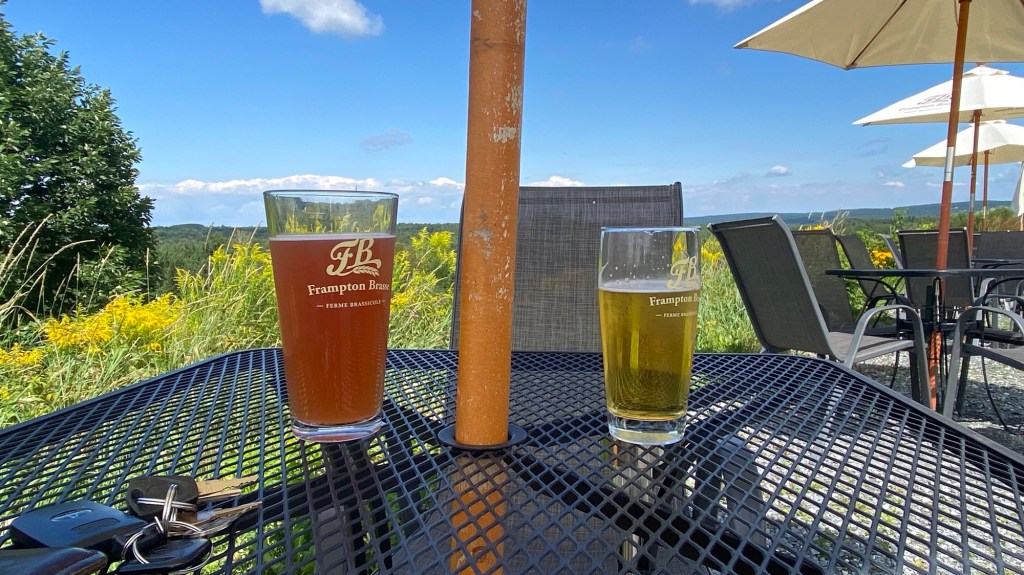
A visit to Frampton Brasse is never a waste of time, and we couldn’t miss the opportunity to try what is produced so locally! Blue skies, a light breeze, long views, excellent beer and a camping spot down by the river afterwards – nope, it’s not time out, and definitely time well spent! How you spend your days is how you live your life and all that. I think we’re beginning to figure out this retirement lark.
Glasses half full
It was hard to drag ourselves away, but the approaching remnants of tropical storm Debby got us packing up and heading home before the worst of the deluge. The Etchemin will be running high as a result, and likely more navigable by canoe than ever? Hmm…
Thanks for reading and I hope you have a wonderful weekend!
…and a novel idea, inspired by one of the greats. Be warned, I’m an all over the place PlaidCamper at the start of this new year – little of what follows makes any sense. Cabin fever?
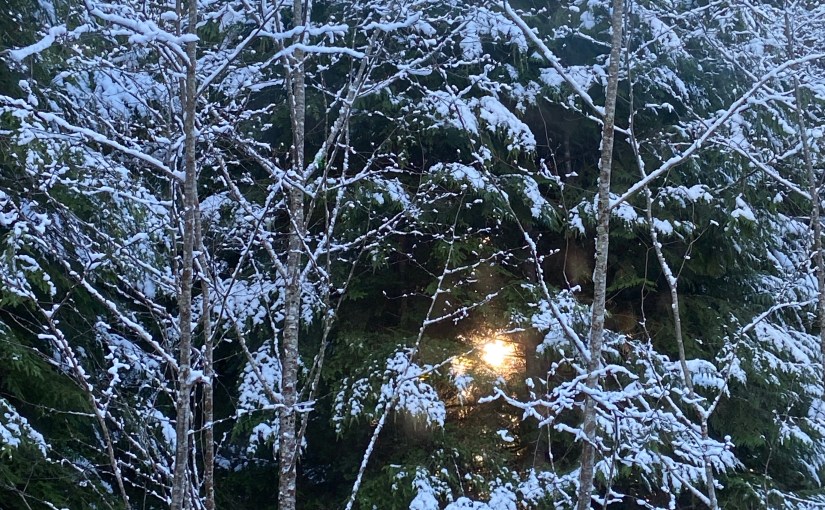
Earlier this week a sprinkling of overnight snow and a bright blue sky morning created the glass tree:
The glass tree, in the next door garden
Given the absence of significant snow for most of December, we were happy to see the shiny and shimmering tree! It didn’t last, but what a sight to lift the spirits. Now, as I write this, it appears we might be at the start of some proper snowfall for the next day or two.
From the office, looking out over our street – snow (and a happy snowman)
Maybe, just maybe, we’ll be heading out on xc skis next week, or even sooner? I can picture it, two confident characters gliding across pristine snowfields and under glass trees, the very essence of beautiful wintry elegance. Like, like, oh, I don’t know, two romantic yet annoyingly likeable figures in a great Russian novel?
Wintry dusting
Where did that come from?! Due to the lack of snow (have I been mentioning that?) we’ve spent more time than usual indoors. Industrious and happy to be in the kitchen, I’ve kept up with baking and eating mince pies. I have to say, they are generally easy enough to make, but my second batch was woeful. Woeful I tell you sir! I’m so terribly, terribly sorry. If I keep baking so badly, whatever will become of us?! Oh, and we have been watching the BBC adaptation (first broadcast 2016) of War and Peace.
I’ve never read the novel, and have to say, knowing nothing of the story before watching, the drama was a blast. The major real events aside, I had no idea what was going to happen, and enjoyed guessing – quite wrongly most times – what might unfold. There were quite a few coincidences and contrivances as the plot barreled along, and these were sometimes hard to accept. To get to better grips with this, I’m going to have a go at reading the novel, and also see if the characters are a bit less broad and maybe more nuanced compared to the adaptation we saw.
Here’s a character!
These were minor quibbles in the grander scheme of the overall experience. It was certainly quite the production, and must have been an expensive enterprise. The grand palaces and houses, the elaborate sets and astonishing costumes were all marvellous, and the large scale battle scenes were convincing. Far better than the usual “five men running past and then around the back of the camera to the front again through the smoke” effect some lower budgeted productions suffer from. The acting was pretty good (to be fair, there was also some capital A “Acting” from one or two, but I always enjoy that in a costume drama) across the enormous cast of characters. Highly recommended if you’ve got an hour or six to spare this winter. Fabulous entertainment!
Before I finish my comments on War and Peace, I do have to mention one thing. I wasn’t going to, but honestly, it’s been haunting me. It is one of the all time great novels, PlaidCamper, and as such, full of insights into what drives humans to do the things they do – for love, honour, greed, power, revenge and so on – we’d expect you to have questions and be haunted. Well yes, all that stuff and the other things I wrote above about high production values, little expense spared, and good acting etc. But, and this might just be me, was I meant to be quite so involved with Prince Vasily’s wig? (Played by Stephen Rea – Prince Vasily, not the wig) I say wig, but was it a wig? Maybe it was his own hair? Bouffant? Coiffure? Sculpture? Creation? Hair piece? Small cat or spaniel? It was a thing of beauty, and I couldn’t stop staring at it. It captured my attention immediately and almost completely. What story? A mighty battle at Borodino, thousands of casualties and Napoleon’s army is approaching Moscow? Uh huh, sure, whatever, sounds serious, but will Prince Vasily’s wig be safe? Will it volunteer to fight the invaders? Now, bear with me, but had it volunteered, I think Vasily’s wig, acting independently of Vasily, could have ended the war. Both sets of soldiers would have been so distracted they’d have forgotten about the bloody fighting… Honestly, it’s on such small details the course of history can change. In my head, anyway.
“Is he still going on about that wig? I think I’ll stay asleep until he stops…”
I believe Stephen Rea was aware of the hair because he kept waggling and raising his eyebrows and smiling at me in a knowing way – he really shouldn’t break the fourth wall like that. Outplayed by a wig, perhaps Stephen was asking for help or trying to dislodge the competition? Mrs. PlaidCamper wasn’t getting the same wiggy vibe, and, if you watch the series, maybe you won’t either. I said to Mrs. PC it was hair loss (that bit works best if read in a heavy Russian accent) she couldn’t see what I could see…
Canada winter – is like Russian winter, no?
Goodness, that was a long aside, almost like a, like a, oh, I don’t know, an unlikely contrivance in a nineteenth century novel.
Where were we? Oh yes, gliding across the snowy plains. In truth, at least one of us will be absolute-ski exhausted after the first half hour and wondering where the nearest cafe is. Our plan is to tackle the flattest trails on the Plains of Abraham, so finding a cafe nearby won’t be too difficult. A very well earned hot chocolate, and if there’s a pastry, why not? With all this new snow, we’ll be needing extra pastries to maintain a sensible calorie balance. (My thumbs are already on – or is it off? – the (nonexistent) scale, like an unscrupulous merchant in a nineteenth century novel…) Are you tired of this yet? Tired, like you can get reading a long nine- Please, stop it PlaidCamper!
Almost done! I went out with Scout a little earlier, and she was thrilled to be able to dig, even if the snow wasn’t really deep enough:
Digging it“Oh. Nothing there. Somewhat shallow, PlaidCamper! Could you turn the camera away – I’ve dug the hole, might as well pee in it!”
Scout! We are out in society! If you behave like this, whatever will become of us? Consider our audience, madam! And what’s this about shallow? You certainly know how to wound a fellow…
I shall leave it here for this week, ego bruised, feeling fragile but not shattered, like a, like a, oh, I don’t know, a glass tree or an overwrought character in a – I’ll stop, you know how it goes…
Goodness, you’re still here and have a question? What about the novel idea, PlaidCamper – you mentioned it at the start? Oh, that. I’m no nineteenth century novelist (no, no, really, and thank you, you’re so very kind) but I was inspired by old LT to have a go at a short story of my own. It’s about a famous actor, his wig, a down on his luck baker and his incontinent pooch. The title? “Woe & Pees!” Yup – when the BBC drama department comes knocking, I’ll let you know.
Thanks for reading, and I hope you have a wonderful weekend!
“Oh come on, PlaidCamper! Wounded? Really?! Stop sulking – I forgive me! Now, have you seen the new snow? Let’s get out there!”This was the new snow yesterday – phew! Let’s get out there!
We’re enjoying (I think I mean that) a brief heatwave this week, one that is threatening thunder this afternoon (Thursday) and all through tomorrow. It’s been too hot – hot, like a furnace – to charge about doing anything interesting aside from walking with Scout and retreating from the woods due to the resurgent mosquitoes. I got multiple bites on my right shoulder after something got in under my long sleeved shirt. It chewed away for quite some time until I noticed. Itchy…
Bugs! You can’t see them, but they’re there…
The furnace outside has meant mostly staying inside, time well spent with reading, writing and watching a few movies. The best of the movie bunch for me was The Furnace, (yup, you’ve seen what I’ve done here) an Australian outback western set in the late 1800s.
Heat induced stupor
Spectacular locations, more bugs than even in our local woods, and a ripping yarn full of interesting characters doing bad and not so bad things due to greed over gold. An exciting and thought provoking piece, with lots to chew over regarding race, avarice, indigenous rights, immigrant experiences and camels. Yup, camels. If you don’t like camels, don’t watch the movie, you’ll only get the hump. (It’s warm, I’m tired, this is the best I’ve got…) If you’re interested, here’s a better review: The Furnace Guardian review – I think this review acknowledges the Treasure of the Sierra Madre vibe, and I’d agree. If it’s not up to that level, it’s still decent enough.
Gold? Sort of…
The book I enjoyed most this week was Snow Country by Sebastian Faulks. If you liked Human Traces (I did, even if it was long winded at times) or Birdsong or A Fool’s Alphabet then you’ll likely enjoy this one. What’s it about? Love, death, grief, recovery, political tension between the wars, identity and belonging, small kindnesses in the midst of tragedy, and, as I’ve found with most of his novels, it stays with you. Also, let’s be honest, snowy Austrian mountain scenes were just the thing to read in a heatwave and after watching the outback movie!
With the heat allegedly diminishing after the weekend, we’ll be back outside a bit more and looking to explore Quebec in early fall. It’s starting to get colourful out there.
Fall colours emerging
Thanks for reading, and I hope you have a wonderful weekend!
I was happily engrossed in making mincemeat for festive pies the other day, noodling away in the kitchen, mostly adhering to Nigel Slater’s instructions as written in “The Christmas Chronicles” and letting my mind wander in between the more precise measurements. At this point, I should say a huge thank you to Mrs. PC. She knows I’m not overly fond of the Christmas season, although I do like an excuse to cook something seasonal, and she knows I’m often most contented in the kitchen. On top of my usual lack of enthusiasm for “all that tinsel and other shiny stuff” – I don’t know who said that – I’ve also been moping more than normal for the time of year. Mrs PC’s excellent solution was to give me a copy of the aforementioned Slater collection.
Highly recommended
Aside from the off putting (to me) title, this is a wonderful book. I love Nigel Slater’s descriptive writing, meticulous, maybe even overly fussy and fastidious approach to cooking and life, as well as his dry British wit. Oh, and his recipes are always interesting. Mr. Slater says he’s not so much a Christmas enthusiast as a winter enthusiast, his favourite season, and all this is explored throughout the pages of the book. Christmas is in it, but it’s more a wholehearted embrace of the colder months and how to enjoy them from a kitchen and cooking perspective. (I have to say, as he gets older, it’s clear he enjoys Christmas rather more than he might want you to think, and I suspect it is all to do with the rituals. Having the “right” tree, bringing the box(es) of tree ornaments down from the attic, taking the time to send individually chosen and handwritten – with a fountain pen – cards, making the cake several weeks before, and preparing homemade mincemeat for mince pies. Is he right? Hmm…)
All the right trees
Mrs. PC says of course you like Nigel Slater, you share some of his traits. Do I? I’m not so sure that’s true. I’m a little obsessed by certain rituals. I mean, there is the delight I take in properly preparing coffee, a beer needs to be poured a certain way and in a certain glass, the left sock is always before the right, and doesn’t everyone weigh pasta precisely before cooking it? I think we’ll leave this paragraph here, and move on.
Highly recommended – just the right tasting glass
Where were we? What’s with “a pinch, a dash, a dollop”? I was coming to that. Remember ages ago, at the start of this piece, I mentioned I was letting my mind wander? A few years ago I was chatting with a friend about various chefs, and we agreed Jamie Oliver was a personable chap and had many great recipes. I like his approach – he is quite happy to add a glug, dollop, pinch or dash of an ingredient to his dishes. There are measures given, especially and quite rightly for baking, but there is a freedom with some additions. Our friend said she found that infuriating, and could not get her head around it. How much is a glug or splash? How big of a pinch, and what size is a dollop? What even is a dollop?! She is way more meticulous than me, with a mathematical and scientific mind, and she could not get a handle on Jamie Oliver’s approach. Her frustration makes me appear super-chilled (because I am, of course) and as I added a pinch or two of nutmeg this week, her laughing disbelief at a lack of precise measurement came back to me. I smiled, then added another dash of nutmeg and a glug or two of brandy.
A light frosting
I’ll end with a mince pie story. Or a missed pie story. It’s not terribly exciting – feel free to jump off or head out now if you’re still here.
As a child I absolutely loved mince pies, particularly the ones my mother made. She’d bake a batch and then fend off her four greedy boys with a spatula, telling us to wait until they were cool enough to eat, and eventually letting us try one, even though they were far too hot. Serves us right, and let that be a lesson, laughing at us all teary-eyed and trying to hide how we should have waited a few more minutes. Anyway, too hot, just right or even slightly stale (not that many sat around long enough for that to happen back then) I adored mince pies. One year, early January, aged 11 and about to turn 12, I was draped across the sofa feeling sorry for myself (some things never change – Mrs.PC) and saying I was feeling sick. My mum wanted to use up the rest of the mincemeat, and asked if I’d like a batch of pies for my birthday. Unbelievably, I said “no thanks” and that’s when my mother knew I was truly unwell. To this day I often think about those missed pies, and I’ve made every effort since to eat an extra one or two to make up for the lost ones. I never seem to catch up… Anyway, isn’t this where we came in? Me, in the kitchen, making a few mince pies…
Super chilled
Gosh, is that the time? I’ll finish up now, get this posted, and then settle down with a cup of coffee and perhaps, I don’t know, a mince pie? Coffee first. Start by measuring the beans…
Super chilled! Might as well if he’s started on the coffee and pies. Not going anywhere too soon…
Thanks for reading, and I hope you have a wonderful weekend.
PS The Slater pies are good, but not as good as the ones my mother makes!
I don’t know about you, but lately I’ve been looking for distractions. How is it possible to follow the daily news and not need them? So here are a few of my current distractions, ones that help pleasantly while away a few shutdown hours.
Navajo mug rug (and time ticking on)
The Tony Hillerman Navajo tribal police series. I’m halfway through the first book, The Blessing Way, and I’m really enjoying it. I get a kick out of recognizing some of the places where the story is set, and I like the dialogue of the Navajo characters – it is full of respect between generations, even when there is disagreement. The details about ceremony and song are a plus. I think there are quite a few books in this series, so I’m looking forward to spending more time down in the desert Southwest.
SW desert visit – one day?
The Adrian McKinty series about a Northern Irish Catholic policeman, Sean Duffy, serving in the RUC during the 1980s. I think I’ve now read all the books so far, and given I remember many of the events used as a backdrop for the crime stories, it’s like a strange trip down teenage memory lane. McKinty uses musical references from the time pretty frequently – I often have to follow up a musical lead after reading, see if the tunes were as good, or bad, as the musical snob policeman thinks. It’s a matter of (poor?!) taste. The dialogue is often witty, black humour in dark times, and the frenemy relationships across the divide are interesting.
Alright, away from the book reports. How about my exercise regime? That’s a scary distraction! I’ve been doing some very heavy lifting in the garden, or what is better described as my orchard. Yes, I have an orchard. I was eating an apple and one of the seeds fell on the floor. I picked it up before Scout could snag it, and decided I’d plant the seed. This is what boredom does. I planted it in an empty egg container. Daily watering and conversations worked, as I now have an apple tree. See picture below. Yes it is a tree. Let’s not argue.
The orchard. My apple tree. Yes, it is.
It’s important to have long term and realistic plans, to think beyond the crisis, and the plan here is to make an apple pie using my home grown apples. If you’re free that day, it’ll be baked on 15 September 2030. Please do drop by for a slice of pie. Oh, c’mon, that’s realistic. I have an orchard now. Let’s not argue.
Distancing
I get the sense that these distractions aren’t really holding your attention? Are you looking for a distraction to get away from here? I get it. I’ll stop now – I have to tend to the orchard anyway, you understand how it takes quite a chunk of my time and physical energy – and perhaps I’ll post some more handy distractions next week? I have dozens…
Another handy distraction
Thanks for reading, stay safe, and enjoy your weekend!
Let’s head away from the coast and into the interior this week. A title borrowed from Wallace Stegner, a recommendation to read the Stegner title, and some Saskatchewan memories. What brought this on? Friends from Alberta emailed us last week, catching up on recent events and checking in to see if we had plans to be in Alberta over the summer. Likely yes, and I hope we can mesh our summer schedules and meet up face to face. We’ll have to time it so we see them before or after their planned camping trip to Saskatchewan. Saskatchewan!
I have fond memories of a Saskatchewan road trip and cabin stay we did during our second summer in Canada. Big skies, long distances, empty roads, and the biggest bugs ever. Ever! Also, the week we had in our cabin provided me with some of the most restful sleep I can ever recall. Ever! It was quiet and the backroads cycling was easy. Apparently, parts of Saskatchewan are quite flat. That summer had been rainy just before we set off, so the prairies were a vibrant green and gold – and the abundant insect life was big and bold. The dragon flies were enormous, or so it seemed when cycling through them.
The following year we camped a few nights in the Cypress Hills area, a windswept and beautiful location straddling the Alberta-Saskatchewan border. We had a fun time camped down by the water, aside from some of the biggest mosquitoes ever. Ever!
A different cabin
So what about the title of the post? Wolf Willow? It just so happens I’ve been reading Wallace Stegner’s remarkable book about plains life around the end of the nineteenth and start of the twentieth century. It is a spellbinding account of the trials and tribulations of settlers heading west. It also acknowledges the terrible devastation wrought by those early settlers, on people and place.
Storms, wind, fire, hard winters, dry summers, near starvation, genocide and environmental destruction – this is not a cheery account of that life and those times. Yet Stegner loved the several years he spent there as a child. His account of being a “sensuous savage” running pretty wild with his peers is quite a contrast to the experiences of many children today. There might be an argument made for the rough and tumble of his childhood being a more meaningful experience. Many true and a few tall tales are told, the secondary heading of the complete piece being “a history, a story, and a memory of the last plains frontier.” He had many exciting and striking memories, that’s for sure.
Tough country
There is much on the nature of nature forging identity and character, how a landscape can define a person, even years after they have moved on. For all the tough times and challenging living conditions, Stegner has a real love for his brief – yet formative – years on the prairies, his family scrabbling to survive on what felt at that time like the last frontier. Or the end of the last frontier in North America.
There are any number of wonderfully descriptive prairie passages in the book. The wind is a constant companion:
“Across its empty miles pours the pushing and shouldering wind, a thing you tighten into as a trout tightens into fast water. It is a grassy, clean, exciting wind, with the smell of distance in it, and in its search for whatever it is looking for it turns over every wheat blade and head, every pale primrose, even the ground-hugging grass. It blows yellow-headed blackbirds and hawks and prairie sparrows around the air and ruffles the short tails of meadowlarks on fence posts. In collaboration with the light, it makes lovely and changeful what might be otherwise characterless.”
No need to hurry
The central part of Wolf Willow tells the story of a cattle drive undertaken just as winter approaches. This fictional account is utterly compelling, a tremendous piece of writing about fighting to stay alive in a snowstorm and do a job of work. The main character is a fresh faced romantic recently arrived from England, and he is desperate to be recognized as being stoic and hardbitten like his work colleagues. A few days of driving cattle in plummeting temperatures forces a reassessment of what he saw as a romantic life, and as for achieving the stature he believes his colleagues have? Well, you’ll have to read Wolf Willow to find out. If you do, you won’t be disappointed, although you might find some of the attitudes and prejudices from the time of writing a touch off putting. Maybe treat it as a history lesson on past social attitudes, and then enjoy the tales told.
A welcome thaw
From when we were road tripping in Saskatchewan all those years ago, a strong memory is of how friendly people were. One morning we found ourselves in the tiny town of Tisdale, a few hours northeast of Saskatoon. (As an aside, I delight in writing or saying Saskatoon or Saskatchewan. Even better, Saskatoon, Saskatchewan!) Anyway, we were lost, which is hard to do in a small rural town, but soon knew where we were when we inadvertently turned onto a street and found ourselves driving at the head of a parade. Oops. For a few minutes, we headed the floats and marching band. Those friendly townspeople clapped and cheered as we drove on up the street, and was I ever happy to turn off as soon as possible. I’d love to visit again, but I don’t want the townsfolk feeling pressured about putting on a parade…
Captivating country, and never characterless
Ah, Saskatchewan! Land of Corner Gas, a show that told us all we needed to know before heading out on that particular vacation. Corner Gas shows that life has changed on the plains since Stegner’s day! I have to say, prairie life is still a tough business, maybe not Stegner period tough, but there is something so attractive about it nonetheless. Honestly, I’m as hopelessly romantic about it as that young Englishman in Stegner’s story…
Wolf Willow was one of the first prairie shrubs I learned to recognize when we moved to Alberta. One freezing November evening, a kind botanist walked me through a river valley in the prairie edge lands as preparation for a school field trip. The Wolf Willow and Red Osier Dogwoods were a delight, each standing out, even in failing winter light. I’ll be honest, it’s easy to remember a plant with a name as captivating as Wolf Willow. (A quick search earlier revealed it isn’t a willow at all, but that’s okay…)
A good read (Image from Goodread.com)
I think I’ll leave it here, otherwise there’s a danger I could meander on like a slow and muddy river flowing in a summertime prairie valley. In Saskatchewan!
Thanks for reading, and I hope you have a wonderful weekend!
All the photographs this week are from Alberta prairie visits in previous years. I have photographs from our SK trips, but couldn’t find them this week. Maybe we need to plan another SK trip…
Scout and I often end up at Indignant Cove, and often on a Monday evening. Mrs. PC is at her exercise class, keeping healthy and in shape, thinking about the future, all that stuff about using it now so you still have it later. I get a bit hot under the collar thinking about exercise, and tend to wander off with the dog to find a quiet place to sit and think about a healthy future. Meditation burns calories, yes?
Be nice to stop here, rest a bit
A gentle – I mean a very brisk and pacy – walk along the Wild Pacific Trail, and we end up at a small shell, gravel and rocky beach overlooking the ocean. Scout gets to chew as many sticks and logs as she can – crunches? – and I clamber and stumble about a bit, huffing and puffing and getting quite exercised each time I slip or trip. It’s a full body workout…
Crunch, chew, slip or trip
Most times we are sat there – I mean striding up and down the shore – we spy a bald eagle or two, see fishing boats out on the ocean, and wave “hi” to passers-by up on the trail, especially the joggers and runners. Sometimes the mosquitoes are out in force, so that’s quite a bit of arm stretching and balance, but if there’s a breeze, they are kept at bay.
One recent evening, the tide was getting high, and water was surging up the channel to the left of where we were sitting – just a quick breather. The whump and thump as the weight of the water crashed onto the rocks was loud, even though conditions were relatively calm. A huge thud, rumble and cracking sound reverberated over us when a log smashed onto the rocks. The ground seemed to shake, and that was from a single log on a pleasant evening. Imagine a fierce storm, now that would set your heart racing…
Evening at the cove
Indignant Cove? A strange name, and you won’t find it on maps or charts. I call it that because if we continue on the trail without stopping, walking past the gaps in the logs and rocks where you can access the beach, Scout digs all four paws in and comes to a halt, looking indignant. Why aren’t we going down there? I’ve made a start on that log, and it needs finishing. Can a dog look indignant? Yes. A short, yet healthy and vigorous, game of tug of war ensues, and if Scout wins, we go to the beach. We usually go to the beach.
Haha, we are at Indignant Cove. I knew we’d stop here.
I like the word cove when used to describe a person. It reminds me of the naval fiction by Patrick O’ Brian, set in the early nineteenth century, where you’d expect someone to be called an ill mannered cove if they weren’t of good character. I’m not suggesting Scout is ill mannered, far from it. But she can be an indignant cove if we don’t stop at Indignant Cove.
Well, I’m exhausted after all that, and will have to rest up until next time. Thanks for reading, and have a wonderful weekend!
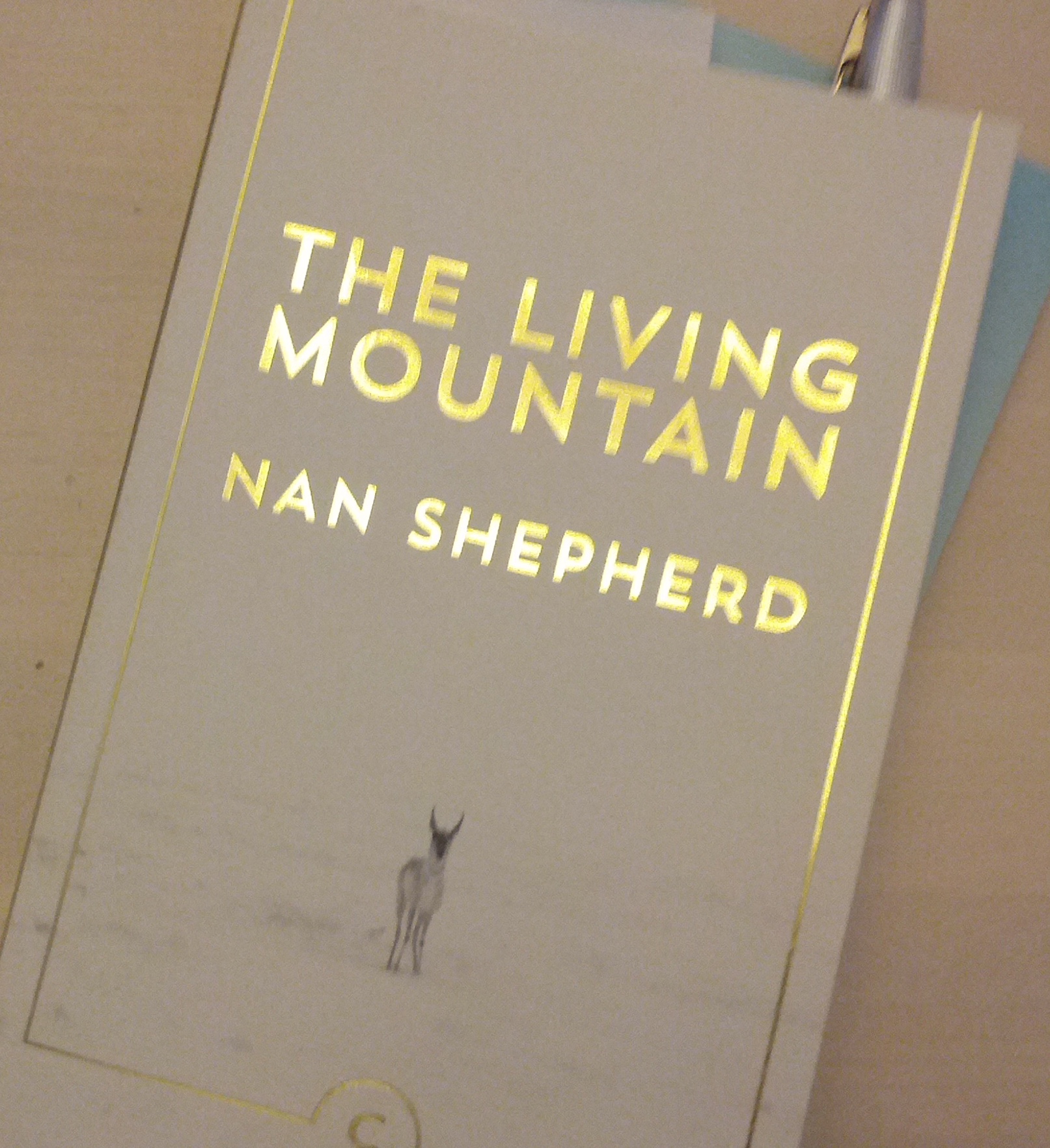
Oh how I wish I’d thought of that post heading, but I borrowed it – the title of a new favourite book, “The Living Mountain” by Nan Shepherd. A wonderful little volume, I’d never heard of it until a few months ago. There’s a story behind that…
Back in late January, Junior announced she’d applied for a chef position with the Fairmont group. Fair enough, a good company to work for by all accounts, and a chance to learn and refine her skills in a different environment, with hotels in beautiful Alberta and BC locations. All true, but the position she’d applied for was in St. Andrews, Scotland. Also beautiful, but somewhat further afield! Two weeks after her announcement, she was on a jet plane heading for new adventures, and has been having a lovely time the past few months, so well done, Junior!
How does this connect to “The Living Mountain” mentioned at the start? The day Junior was on her way, I came home from the airport, rinsed my contact lenses – seemed to be having an issue with welling up – and started to read The Guardian paper online. Would you believe, that very day, they had an article suggesting the top ten books about wilderness Scotland? An interesting mixture of fiction and non-fiction, and because it was about books, I was brave enough to venture BTL and read comments and suggestions. It was there I saw Nan Shepherd recommended over and over, so I managed to track down a copy.
What a find! Nan Shepherd’s slim volume is wonderful, a love letter to the beauty of the Cairngorm mountains, a place she explored her entire life. Her writing is outstanding – intense, detailed and meditative, describing the mountains using all her senses to bring them alive. She loves her mountains, and cannot quite believe their beauty. On describing the clarity of water:
Water so clear cannot be imagined, but must be seen. One must go back, and back again, to look at it, for in the interval memory refuses to recreate its brightness. This is one of the reasons why the high plateau where these streams begin, the streams themselves, their cataracts and rocky beds, the corries, the whole wild enchantment, like a work of art is perpetually new when one returns to it. The mind cannot carry away all that it has to give, nor does it always believe possible what it has carried away.
You find yourself nodding with shared recognition at her delight in the natural world. When she describes silence at altitude, it is really about peace and quiet, rather than the absence of sound:
To bend the ear to silence, is to discover how seldom it is there. Always something moves. When the air is quite still, there is always running water; and up here that is a sound one can hardly lose…but now and then comes an hour when the silence is all but absolute, and listening to it one slips out of time. Such a silence is not a mere negation of sound. it is like a new element, and if water is still sounding with a low far-off murmur, it is no more than the last edge of an element we are leaving, as the last edge of land hangs on the mariner’s horizon.
There is a lovely section about how she is like an excited dog surrounded by the scents of the mountain:
On a hot moist midsummer day, I have caught a rich fruity perfume rising from the mat of grass, moss and wild berry bushes that covers so much of the plateau. The earthy smell of moss, and the soil itself, is best savoured by grubbing. Sometimes the rank smell of deer assails one’s nostril, and in the spring the sharp scent of fire.
I enjoyed how she captured the animal life on and above the mountain, like the eagle rising coil over coil in slow symmetry…and when he has soared to the top of his bent, there comes the level flight as far as the eye can follow, straight, clean, and effortless as breathing. There is a description of hares streaking up a brown hillside like rising smoke – perhaps hoping to avoid becoming prey to the eagle?
Every page reveals how Shepherd increases her love for the mountain. She understands the immeasurable value and importance of time spent in nature:
Yet with what we have, what wealth! I add to it each time I go to the mountain – the eye sees what it didn’t before, or sees in a new way what it has already seen.
What wealth indeed. The challenges to our natural environment have increased enormously in the decades since Shepherd wrote and published. Wild places are under more and more commercial pressure, reducing the opportunities to slow down, immerse the physical (and mental) self in outdoor beauty, and stop to contemplate the treasures we have. It is splendid to have books like “The Living Mountain”, but I wonder if in the near future, her record and those like it, will be all that remains, that we’ll be reading about instead of experiencing first hand the wonders of our natural world?
Many years ago, we took a camping trip in Scotland when Junior was a wee bairn. It was her first time camping, and she enjoyed it, from being bathed in a washing up bowl to sleeping soundly (phew!) in a tent, despite the wind and rain outside. Sometimes sunny, oftentimes wild and woolly, it was a fun trip. We got as far as the Cairngorms, but didn’t spend any significant time up there. Better informed now, thanks to Nan Shepherd, and with Junior as an advance party, it seems as if we’ll have to arrange another trip…
I’ll stop now, because otherwise all I’ll do is continue to select passages to illustrate how much I enjoyed Nan Shepherd’s mountain musing. The best thing is to get a copy – I heartily recommend it.
Thanks for reading, and have a wonderful weekend!
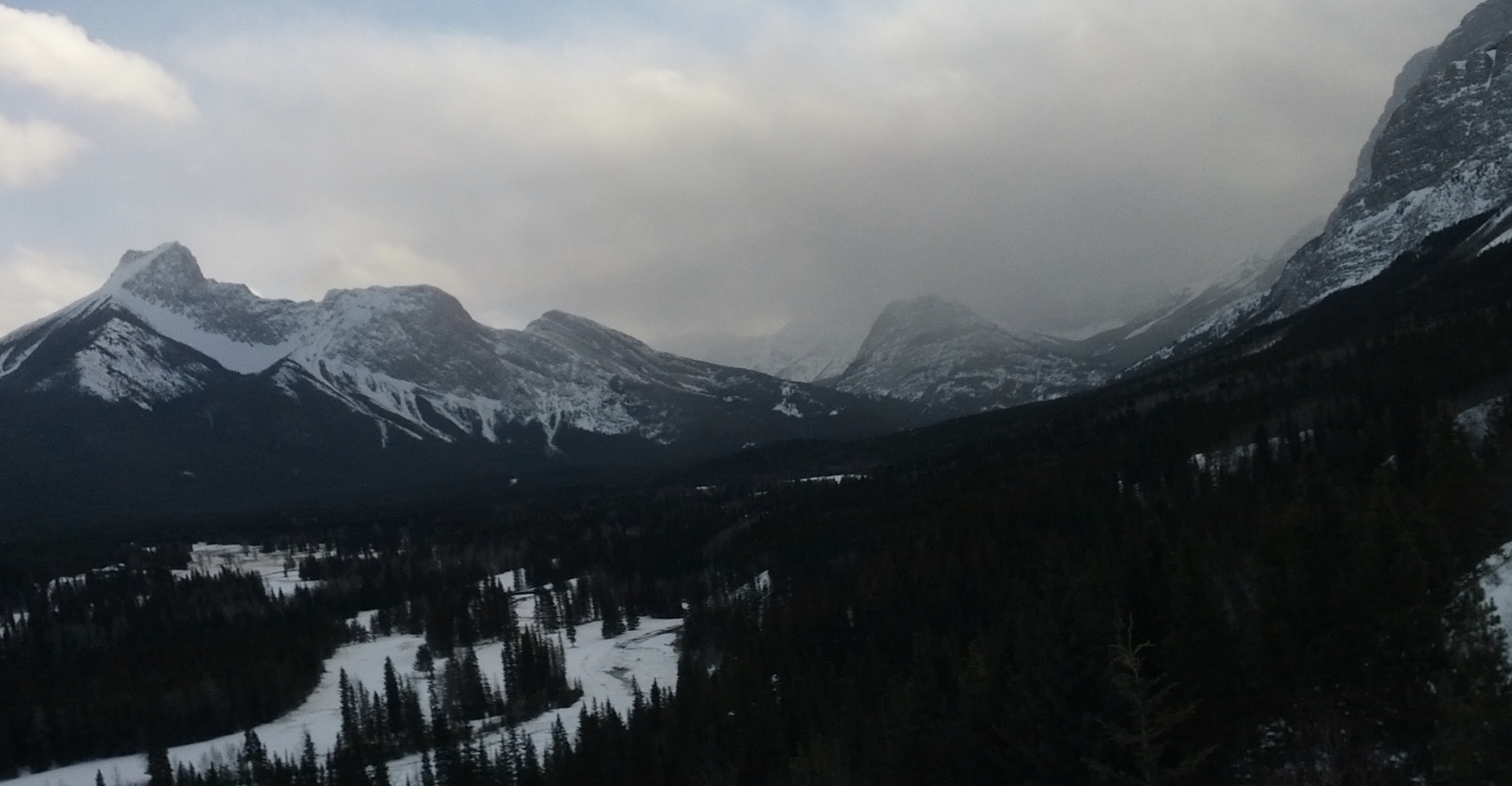
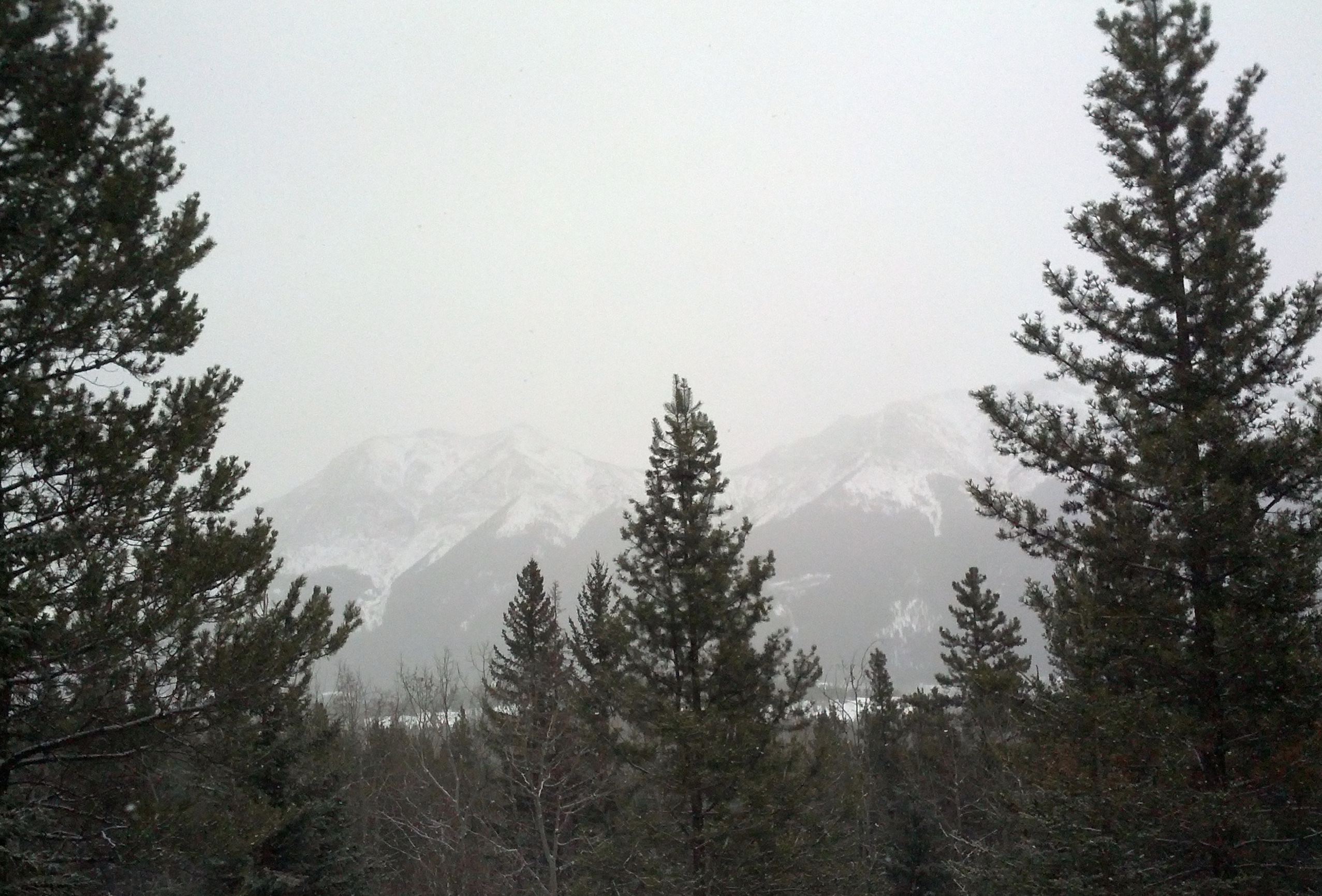
PS The photographs featured this week were all taken out and about in the past six months – not of the Cairngorms, but in our living mountains here in Alberta.
Beer and books! Two of my favourite things, and who doesn’t like a good read with a glass of beer at hand? Throw in a campfire, and all is well. (The good question is buried – and then raised – further down. Read on if important questions matter to you…)
Research is vital, and with the weather improving, and campfire season pretty much here, I forced myself to go to two beer festivals two weekends in a row, as well as a tasting at our local beer store to search out new favourites. Research is hard work, but it is work I take very seriously, and I’ll even put in a little overtime if necessary, to get the job done. An unpaid and overworked PlaidCamper. Preparation, preparation, preparation. I know you feel my pain…
Exhaustive (exhausting?) research…
So, that is something about the beer part, with more to follow. The book part? Read on!
I was strolling along the banks of the Bow the other day, and I spotted a guy in waders fishing from the gravel on the far side. Behind him, up on the bank was a cooler. Am I right in thinking the cooler could only have been for beer? The sight put me in mind of Norman Maclean’s A River Runs Through It.
Lovely, but where’s the beer?
What a book! If you’ve read it, then you’ll know I am seriously underselling it by saying there is a lot of fishing, family feuding, and drinking in this story. I’m being truthful, but the story includes so much more. If you haven’t read it, you’ve got a treat ahead should you so choose. Anyway, back to my tenuous book and beer stuff.
Maclean’s narrator and his brother return to where they left eight bottles of beer cooling in the river. They’ve been fishing on a very hot day, the fishing has not been too rewarding, and they are looking forward to a cold one:
“God, let’s get that beer,” I said.
Paul kept spinning a bottle opener around his little finger. We were so dry that we could feel in our ears that we were trying to swallow. For talk, we only repeated the lyric refrain of the summer fisherman, “A bottle of beer sure would taste good.”
Sure tastes good
They are disappointed – to put it mildly – that their brother-in-law, Neal, and his acquaintance, have finished off all the beer. These two didn’t take the trip for the fishing, they had a different activity in mind. The brothers spy the amorous culprits asleep – passed out? – buck naked and burning in the high heat of a Montana afternoon. Backsides are red, words are spoken, and actions are taken. You’ll have to read the story to find out more. It is a colourful episode in a book full of colourful episodes.
A River Runs Through It is wonderful on many levels, full of life, death, sadness and grace. But me being shallow, like a stream in mid-summer, I’ve always wondered about that beer in the river – Maclean wrote it was either Highlander or Kessler – was it any good, and what would be a good river beer today? (I know, one of the finest stories a person could read, and that is what I’m thinking…) The brothers were pretty annoyed, and I can’t imagine they’d have been quite so upset over a missing six pack of Bud. Both the breweries Maclean mentioned went under in the twentieth century, maybe under the Anheuser-Busch onslaught, although with the recent resurgence in craft beer, the Highlander name is being used once again in Missoula.
Also tastes good
Anyway, this is my question – what would be a good beer, river-cooled a la Maclean, to enjoy after an afternoon of fishing? Yup, heady stuff, and I have to find an answer. Strange to be occupied by this question, given I have hardly ever fished, and I hardly ever drink beer. One of those is true.
The beers we researched at the Calgary and Canmore BeerFests (Mrs PC and our Canmore friends were onhand to share the work – I couldn’t tackle this alone) are all relatively recent vintages. Some of the start ups are mere months old, and I admire the enthusiasm, craft and commitment all the makers have in aiming to produce excellent beer.
Up until last year, my choice for the beer in the river would have been Great Northern Brewing’sGoing to the Sun IPA. Aptly, it is made in Montana, and an absolute gem for a warm afternoon. Not so hoppy as to be too dry on the finish, it is a definite river beer contender.
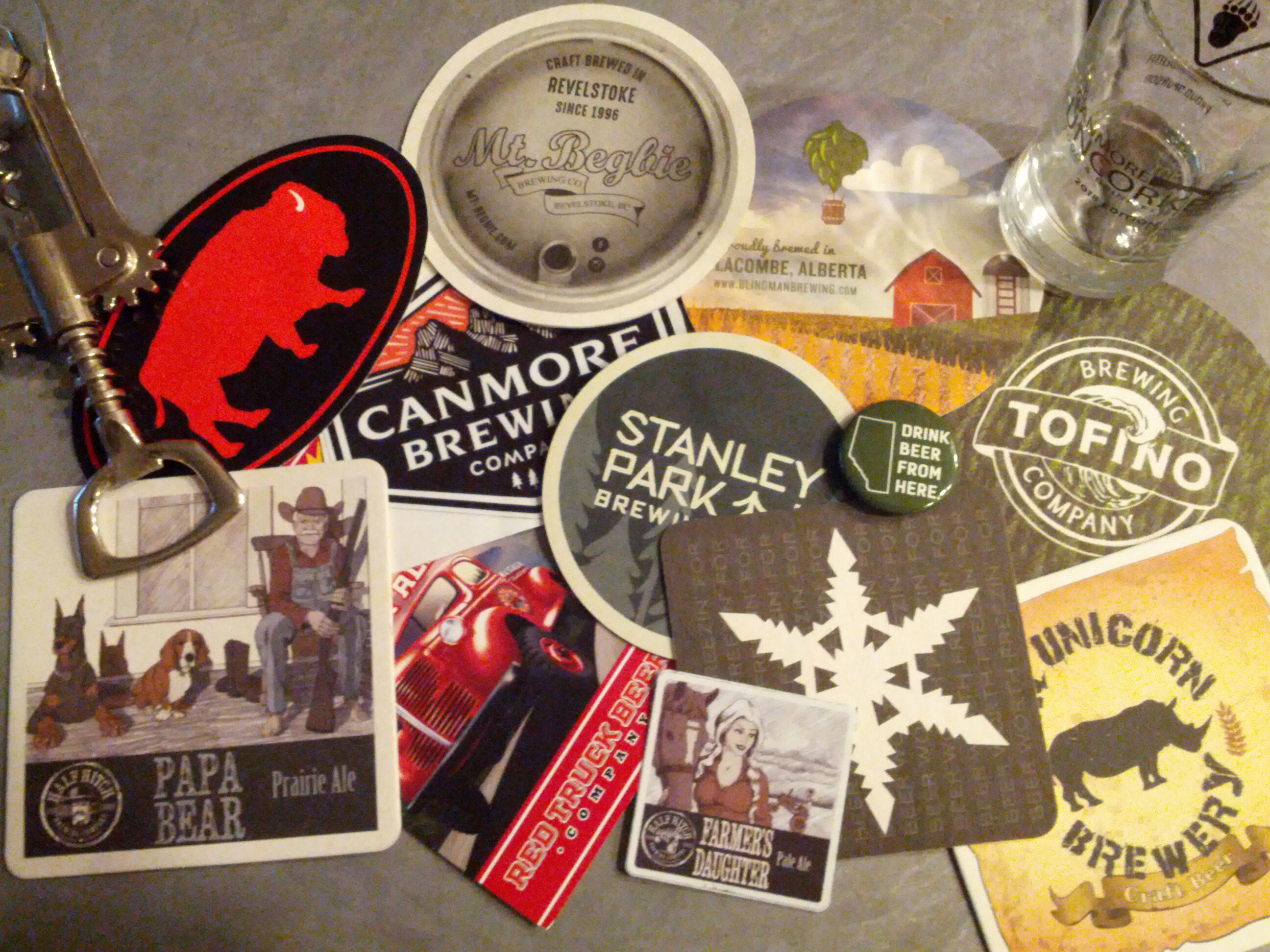
However, our recent research revealed many other possibilities. If the brothers could have sourced it back in the day, I believe the Papa Bear Prairie Ale from the Half Hitch Brewing Company would have hit the spot. Or the Farmer’s Daughter Pale Ale from the same brewery. And if the name doesn’t put a person off, Red Bison Brewing’sParty Pants Pale Ale is also a winner. (Regular readers recognize I love a little alliteration, but steady on there, Red Bison…)
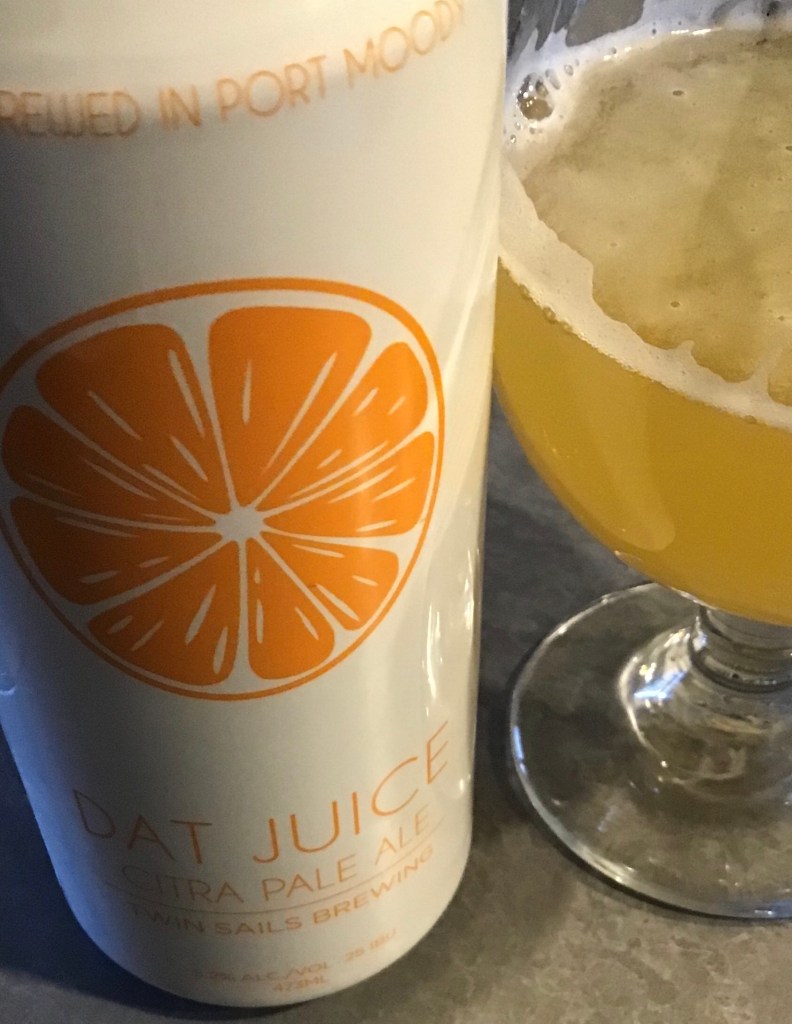
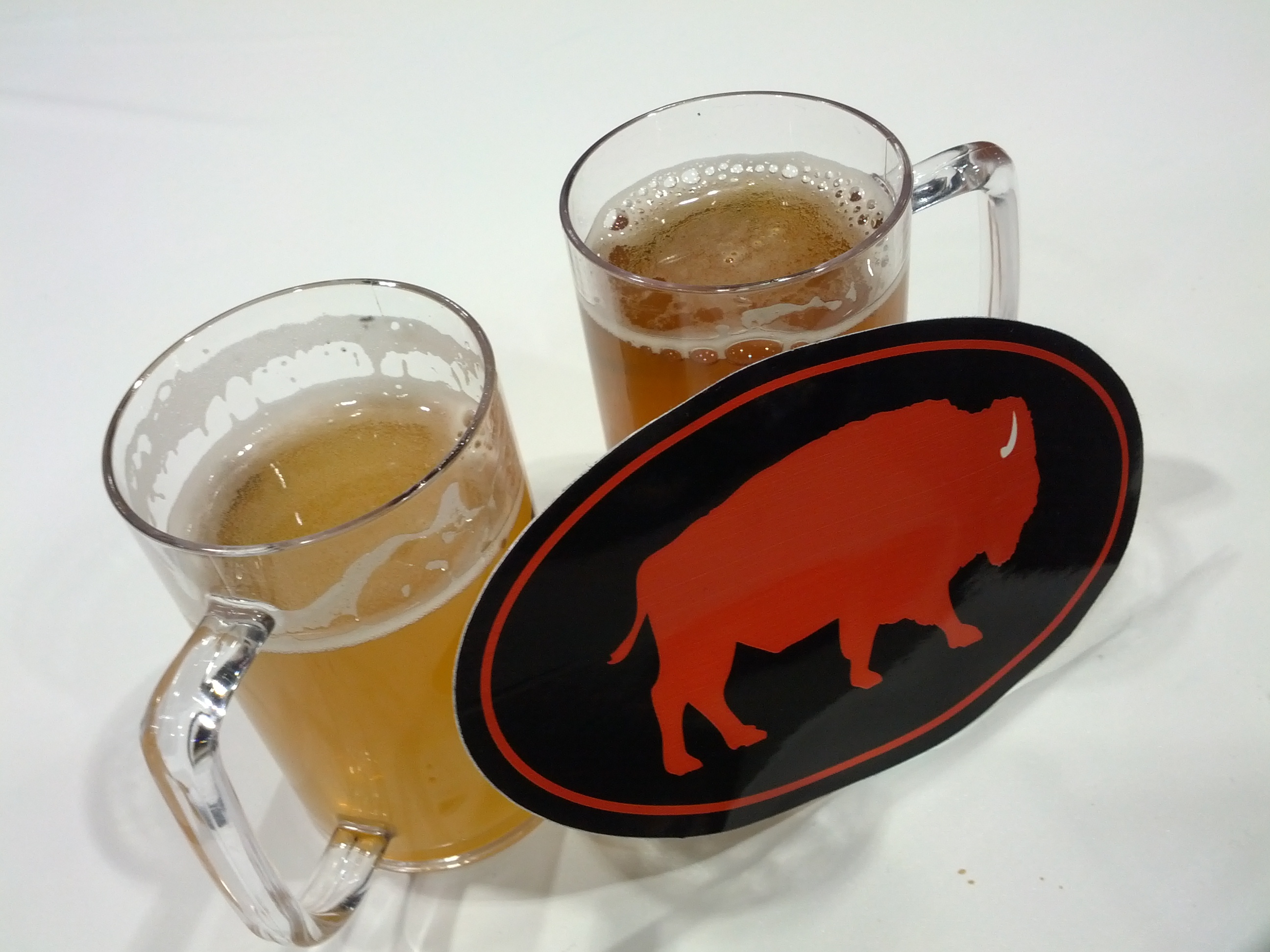
Party Pants Pale Ale on the left
Honestly, I could list and share many of the beers from our two recent BeerFest experiences that were wonderful enough to be left in a river – in a good way – or opened and enjoyed by a campfire over the coming season. Perhaps I’ll write a short follow up in the next week or two to mention and recommend some of these other beers. Be a shame to let all that research go unshared!
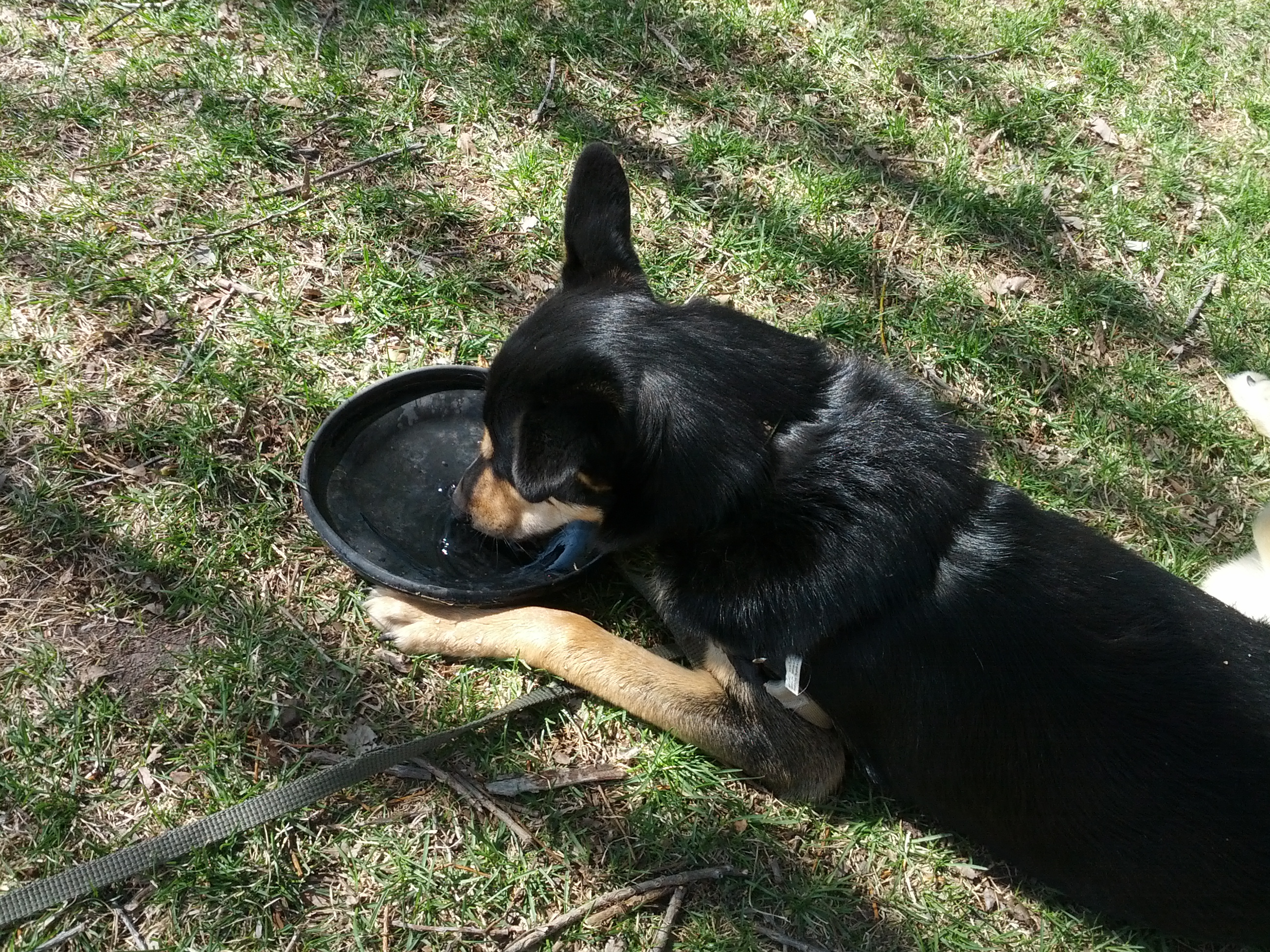
“Beer? No thanks. I drink water from my frisbee!”
I can’t help but think if only a certain someone would simply sit down, perhaps with an optional small glass of APA, turn off the (three?!) televisions, and read a few documents and reports, the world might be a tad more relaxed.
Thanks for reading, and perhaps you have a different “beer in a story” suggestion? Or a recommendation for a post-fishing river-cooled beer for Maclean’s story? If I can find it, I promise to try it…
I’ve never read it. I believe it is a favourite of Old Ma PlaidCamper, and I remember seeing this title on the bookshelves when I was a child, but was never tempted – I thought they’d misspelled wolf. Oh dear… It had a gloomy cover, and Ma told me it was not really about a lighthouse. Now I’m older, and almost ready to read a story that might not be about a lighthouse, maybe I should give it a go? Also, I’m ready to believe Virginia wasn’t a wolf.
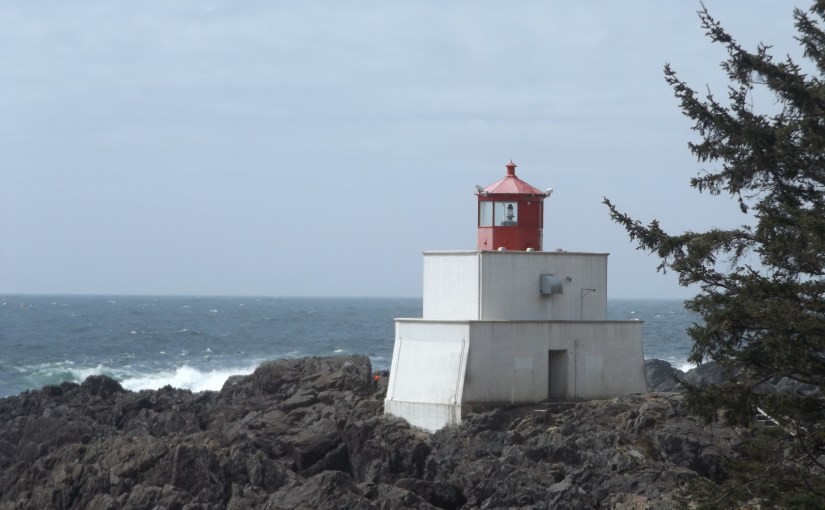
A good pointIn between the rain showers and strong and stormy winds earlier this week, we went for a walk to the lighthouse. Our walks don’t always have a point, other than to enjoy being out, but this one did, Amphitrite Point! Who wouldn’t want to visit a location named for a Greek sea goddess? For once, it was the destination, not the journey, man.
Initially, the lighthouse wasn’t the reason for the walk, but it turned out all the trails and little beaches on the ocean side of Ucluelet were closed due to heavy seas washing onto the shore. Oh no! What to do? There’s a dog needing a walk! So to the lighthouse we went, to take in the view, if not the trail.
PeekingWell, we were fortunate. As it sometimes does on a day forecast to have incessant rain, the skies cleared, and sun emerged for over an hour. We could see the clouds amassing to the southwest, and a grey wall was creeping towards us from way out west, but that didn’t arrive until we were ready to depart. It wasn’t really creeping, as we found out when the raindrops hit us later, hard and fast, and we would have been soaked had we stayed any longer.
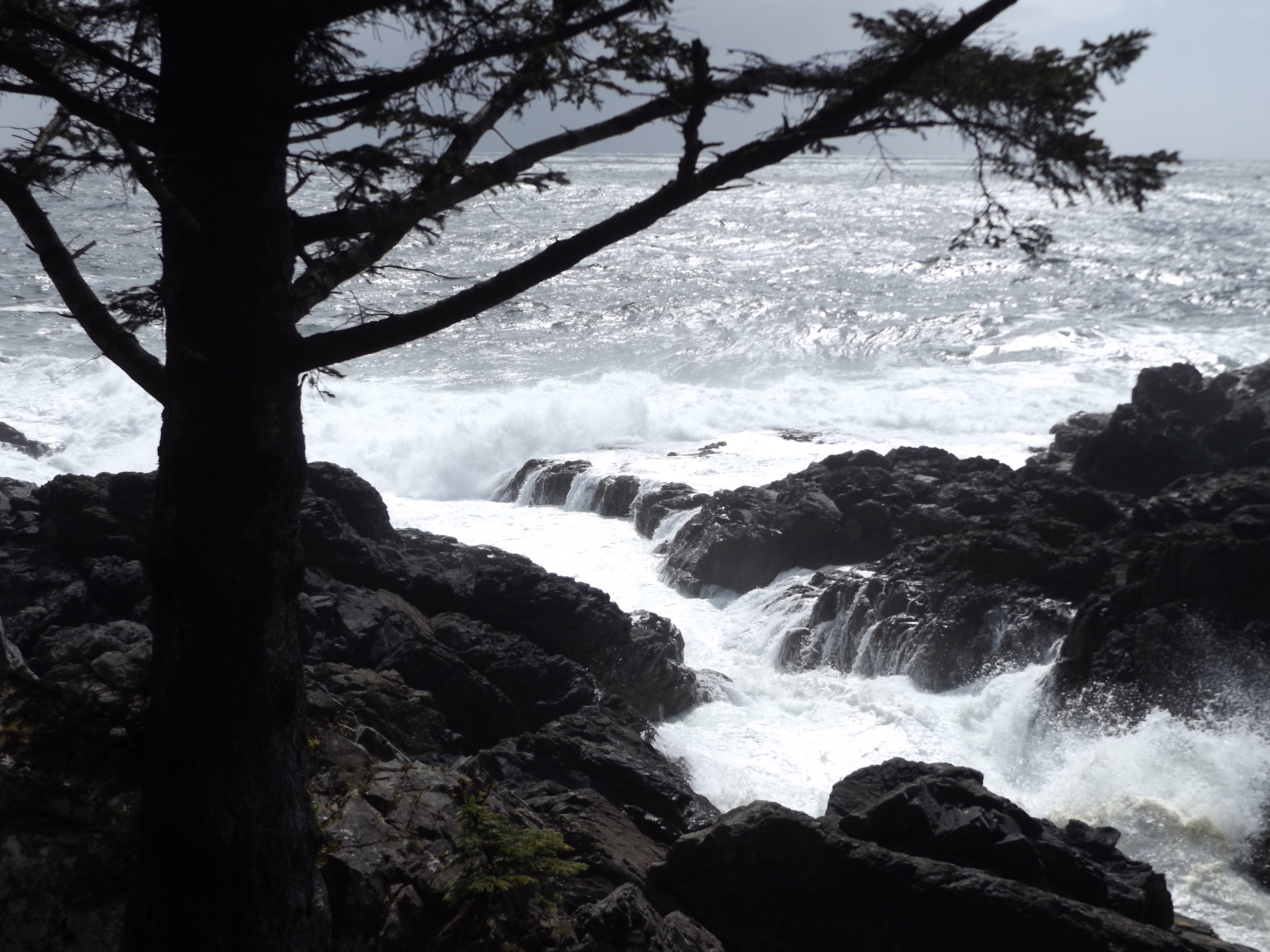
Did I mention the trail was closed for safety reasons? Don’t tell anyone, but we did head south of the lighthouse, for barely a hundred metres, to a rocky outcrop high above the busy ocean. From there, you can lean out and peek back to the Broken Islands, and across to the lighthouse itself. Again, don’t tell, but there is a bench off a short side path, and it is completely hidden from the main trail and sheltered by trees and shrubs. Facing west, it is a perfect little sun trap, and often warm even on overcast days. There we sat, protected from the buffeting winds, admiring sea birds battling the weather, and watching the waves crashing against the rocks. A bald eagle flew just over our heads. For a few seconds it seemed almost motionless, hanging there, facing into the wind before disappearing behind the trees further south. (Sharp as ever, I pulled out my camera and took a fabulous picture of the trees it flew beyond…)
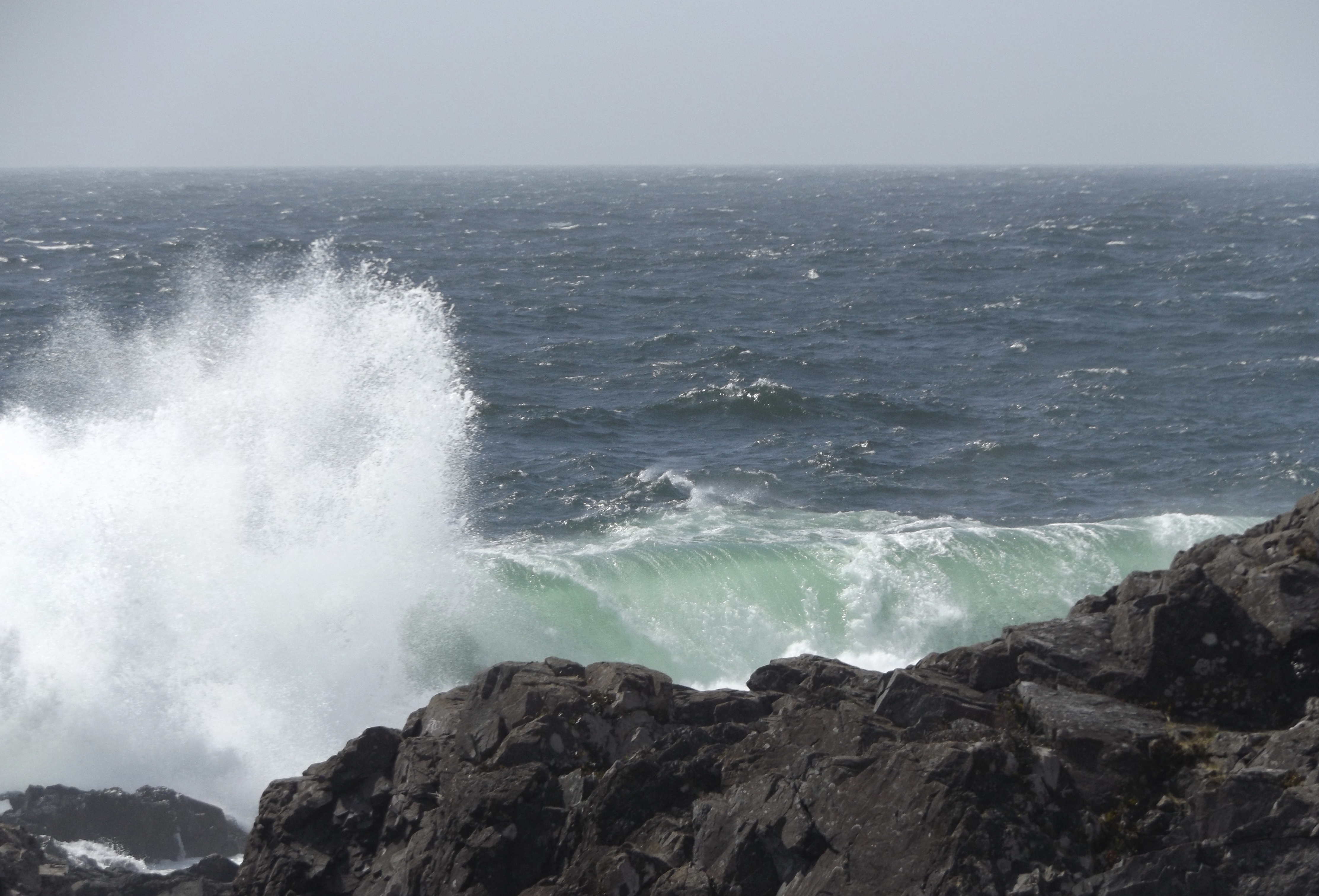
The colours shifted from blue to grey as the afternoon wore on, and the heavy weather started to be felt. It was a real treat to sit and watch the changes. I tried to zoom in and capture the glints and curl of green inside a wave before it collapsed under its own weight and onto the shore. The constant heave and swell of the water further out was mesmerizing and unpredictable. Just when I thought I’d figured out a wave pattern, the ocean shifted and remade itself, tidal pull and undertow, crashing in and washing out with a roar, the booms and hissing audible above the rush of wind.
Changing…It was an exhilarating hour or so, full of natural energy, and sights and sounds to thrill the observer. Drawn to the ocean, my gaze barely went to the lighthouse, but it is quite the sight. Small and stocky, planted firm among the black rocks, it isn’t a grand construction, but it looks purposeful, doing an important job on the point.
DepartingWe left when we realized that it was more than ocean spray getting our faces wet, and when the sea had no more hints of green or blue, but was as grey as the wall of cloud just offshore. The wind had never died down, and was now beginning to shake the trees with increasing ferocity – time to wander back, picking up the pace, but with one last glance back to the lighthouse. Perhaps I’ll give the book a go, now it is on my mind. Have you read it?
Nope, haven’t read it. I’m a dog.Thanks for reading, and have a wonderful weekend!


























 OldPlaidCamper